
Bonus Article: Process Is Everything
Or, what I learned from watching four versions of Beauty and The Beast with my sick kids

My whole family came down with a horrific flu last week. My kids both missed an entire week of school. My husband and I thought we might get out of it, but by day three we were all as hot as baked potatoes fresh from the oven and taking turns puking. It was one of those rare, special breeds of virus that hits you in the stomach and the nasal passages, while also making your muscles feel like fire and your head like it’s in a vice.
Normally what we do in this situation is turn the TV on and leave it on until our family is somewhat functional again. Unfortunately, as I wrote about here, we made the strategic decision last month to cancel all of our streaming subscriptions in exchange for a dozen high-quality DVDs, in the hopes that this would reduce our screen time and shield our children from some of the worst, addictive content that the internet has to offer. This strategy has been so successful that we hardly watch TV anymore, which is probably good for my children’s development, but definitely more exhausting for me.
One of our chosen few films is Beauty and The Beast. Say what you like about Belle having Stockholm Syndrome*; this film is a masterpiece. It remains one of the only animated films in history to have been nominated for the Academy Award for Best Picture, and it was a major box-office success upon release. It was made by some of the most talented creative geniuses in film animation history, and the songs were written by legendary composers and sung by some of Broadway’s best talent. And of course, every scene is hand drawn. At the risk of sounding like a real sentimental geezer, they just don’t make shit like this anymore.
But even the best films get boring once you have seen them dozens of times, so we decided to do something we hadn’t done before and actually explore the DVD bonus features. You see, our Beauty and the Beast DVD, which I acquired on the French craigslist equivalent for a whopping four euros, happens to be a special edition, and includes many earlier releases of the film: a longer, uncut version that’s mostly like the original but with extra scenes and songs, the pre-release version that was shown at a film festival before the final version was complete (including entire segments with only the original black and white drawings), and the original story-board version of the film with just a sequencing of still images.
We watched all four. That’s how sick and bored we were.
And guess what? Not only were they amazing, I feel like I learned more about the creative process, and did more (deep) reflecting on my own writing process, than I have since I started work on my book.
You see, at the risk of sounding hopelessly naive and inexperienced (which I am when it comes to book-writing), no one ever told me that writing is an iterative process. In high school and college, I did a lot of non-fiction essay writing—and I prided myself on being pretty good at it—but…I outlined once, drafted, then made a few edits and handed it in. I’d get it back with a grade and some comments and that was that. There was rarely (if ever) an opportunity to rewrite it and make it better.
Since I was a straight-A student, I kind of figured I’d just write my non-fiction book the same way I wrote my essays in high-school: first an outline, then a draft, then maybe a few polishing edits, et voila! Donezo.
My friends, this is not how you write a good book. It was my agent who had the hard job of telling me that I am no longer in high school, and that in today’s publishing world only the best of the best get a book deal. In other words, if I wanted to call myself a writer, I had to be not just good, but excellent, and excellence does not happen in one draft. I believe she told me to rewrite my sample chapter approximately twelve times before we took it to publishers, at which point I was very close to firing her out of sheer frustration (except that no one else would have signed me at that point). Fortunately, I happened to know a few other writers, who gently helped me to own up to the fact that, in the words of Taylor Swift, “It’s me, hi, I’m the problem, it’s me.”
My next move was to go out and pick up a second-hand copy of Anne Lamott’s Bird by Bird—which should be required reading for every student and certainly for every writer—and gasped with horror as she retold, with typical humor and flair, the story of her publisher refusing her first completed manuscript and rescinding the deal, after she had already spent the advance. But she insisted on another chance, tore her story apart and reconfigured it, overhauled entire chapters and sections, and birthed a phoenix from the ashes.
By the time I finished reading that, I was beginning to get it.
Now back to these four versions of Beauty and the Beast. By far the most interesting version was the first one, which was actually just the first twenty minutes or so of the film as it was originally conceived, in story-board form (kind of like watching a comic strip with music and narration), but apparently it took the entire creative team of 20+ people almost a year to create it. And it was…awful.
Okay, maybe awful is a bit of an extreme statement. It was just incredibly boring; and boring is worse than awful when you work in entertainment.
The original director had tried to stay too true to the original fairy tale. There was no music. The characters felt flat and un-relatable; stuck in the 18th century without a modern twist. The humor was slapstick and forced. The story-line meandered into irrelevant details. After almost a year of work and a third of the budget spent, the Disney executives decided to start over from scratch, with two new, far less experienced directors, and an entirely new creative vision.
On some level, this is a bit depressing, because it makes you wonder whether the film could ever have been what is was without the change in directors. Maybe the original guy just didn’t have what it takes. This is the feeling that will crush you as a creative: the fear that maybe you just don’t have what it takes—or not for this project, anyway.
The take-away from this story could be: some folks just have it, and some do not. But 90% of the team remained in tact for the second iteration, so what I choose to take away from it, instead, is that you shouldn’t be afraid to scrap a year’s worth of hard work, money, and investment if what you created is not excellent, because in competitive, creative fields like entertainment and publishing and media, excellence is the only way you survive. You can start out bad, scrap it, and still make a masterpiece out of the rubble.
Scrapping months or years worth of work is undeniably difficult, but worth it, because there is nothing quite like creative excellence. It’s hard to define, but you know it when you see it. In retrospect, this is perhaps why I felt so compelled to pull the plug on our TV subscriptions in exchange for a handful of vintage DVDs. I didn’t want my children to consume endless mediocrity. I want them to appreciate excellence. Because if you don’t know how to appreciate excellence, you cannot create excellence. And perhaps more importantly, even if you never produce anything excellent yourself, there is a real intrinsic pleasure that comes from recognizing and experiencing excellence. When people say that this or that work of art changed their lives, they are not lying. The best art has that power, but only the best.
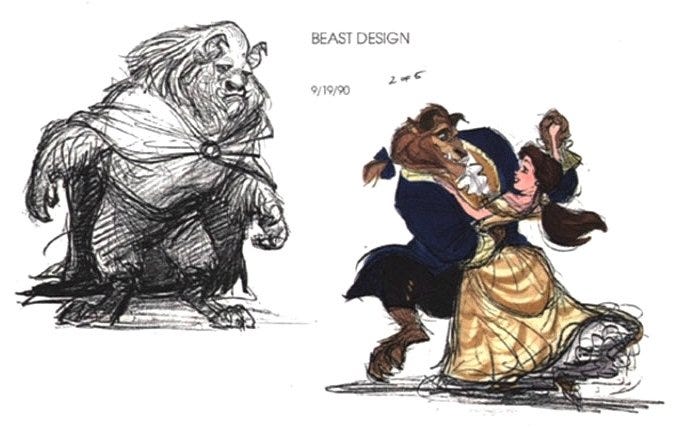
After we finished watching the crappy, original story-board version of Beauty and the Beast, we moved on to the pre-release version (after all, we were not about to get off the couch). This was perhaps my favorite version to watch, because the story was fully in place, the songs were complete, the actors’ voices were there, but there were these entire segments that were just hand-drawn pencil sketches without any of the colors and refinement of the final film. I just loved watching these segments, the same way that I love watching creators on TikTok make sweaters from the wool of a sheep that they sheared themselves, or watching Paul Hollywood bake a loaf of bread from scratch. There’s a sort of ecstasy, I find, in watching an expert practice their craft; in seeing the process behind the final creation.
I don’t think people realize that, as few as thirty years ago, every animated film was hand-drawn, frame by frame, by people sitting at desks with pencils. The amount of effort that went into creating these movies was mind-blowing. Because of that, they couldn’t afford to fill in any more detail than was absolutely necessary until they were absolutely certain that the scene was right. The process was inherently collaborative and iterative. Only when the concept was fully validated did they start refining the sketches or adding color. That’s something every writer can learn from.
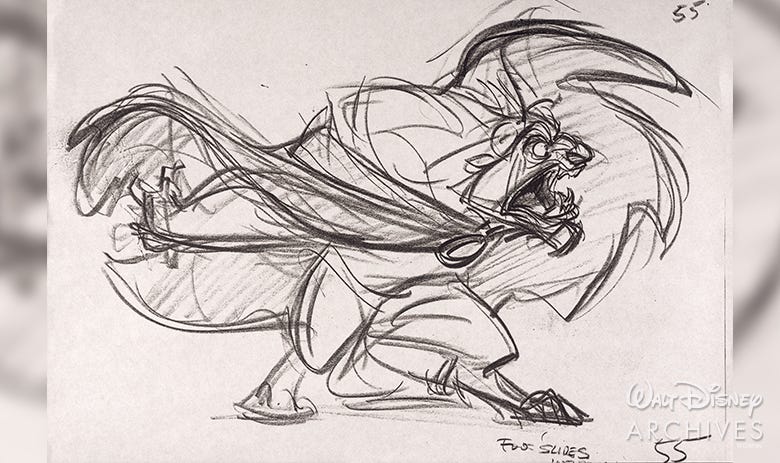
And I strongly suspect that there was something about the pain of creating that way—by hand, frame by frame, with pencil and paper—that brought out the best creative abilities in the team. When something is painfully effortful to make, you think hard and long about it. If you have to spend days carding and spinning the wool before you knit the sweater, you’re probably gonna do your best to make sure you nail the sweater design and the knitting. It’s got to be a damn good sweater. If, however, your sweater is going to be made by a machine from acrylic yarn that was spun by another machine, then you can slap together a crap design and hope it sells with the right influencer marketing campaign.
I think Beauty and the Beast was the pinnacle of animated film-making. Movies like Up, another, more recent animated film that also won a nomination for Best Picture, just don’t hold a candle, in my humble opinion. Sure, there are some good moments, but it’s not a creative work of genius. Maybe—just maybe—its because the creators don’t suffer the same way anymore.
Then again, what do I know? I don’t work in animation. I’m just a tweedy curmudgeon with a nostalgic itch for the Paleolithic.
Here’s what I do know, though, even though I am still a debutante in the writing world and have yet to publish my first book: writing is iterative, much like animation. You start with a storyboard, then shift to charcoal, then more refined black and white pencil-drawings, and finally to color. Critically, you never move to the next phase until you are happy with the previous one.
You’ll probably need the input of others along the way—many others. No genius operates in a vacuum.
And you have to suffer. There’s no good art without pain. In the age of AI, this is more important than ever. People will tell you that there’s nothing wrong with using AI, that it will eventually become as good as any human at writing books, that the purpose of writing—in nonfiction, anyway—is just to convey your ideas accurately and concisely, and AI is better at that than most humans already.
Then again, the people who tell me this are the ones who listen to audio books about productivity at 2X speed while working out. They are not the ones who buy hand-knit sweaters or cry over the Beast’s unlikely redemption.
I do want my ideas to come across clearly and concisely, I am not a creative genius, and I am not above using AI in a limited and strategic way, but the reason I write is as much for the love of process as it is for the result, and I am holding out hope that my struggles will produce something that reaches people in a way that the algorithms cannot. The only way to get there, for me, is through slow, painful iterations, trial and error, humility in the face of honest feedback, and what seems like an increasingly irrational hope that there are still people out there in the world who value craft and excellence.
…
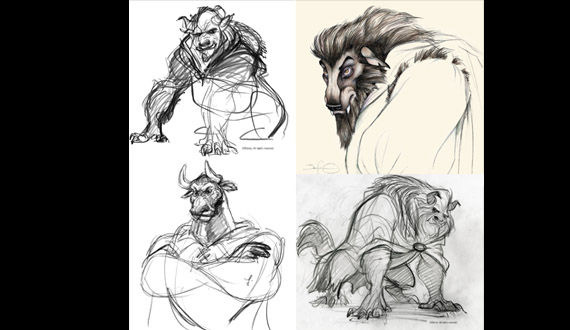
*Footnote: in a documentary about the making of the film (that I also watched while recovering from the plague), one of the writers explained that the team had a major breakthrough when they realized that the film wasn’t really about Belle at all. It’s about the Beast. The film opens with his story. He is only a child (maybe a teen) when the enchantress, disguised as a haggard old woman, visits his castle and asks for shelter. When he turns her away, she transforms him into a hideous beast, and the only way to break the spell is by convincing another to love him before his twenty-first birthday. As the years wear on he loses hope and self-isolates in his enchanted castle until, against all odds, Belle shows up and somehow manages to see the best in him. He learns to love, sets her free, and in doing so, earns her love in return. This breaks the spell—a spell cast on him for a mistake he made when he was little more than a child. In other words, it’s a story of redemption. It’s a story about the transformative power of love and how, under the right circumstances, even the most beastly among us can transform into selfless, kind, and caring people.
Lovely. This reminds me of this great piece by the oatmeal:
Erasers are wonderful - The Oatmeal https://share.google/J8510cCodzX9XyVKq
Also, to date myself, Beauty and the Beast was the first movie I saw in theaters as a young child and it will always have a special place in my heart.
I love this reflection. Watching the early, messy versions of something creative is such a humbling reminder that the magic we see at the end usually comes from a lot of iteration and starting over.
As someone who writes and creates while raising kids, this really resonated with me. Motherhood has been teaching me the same lesson, that the process is slower, messier, and far less linear than I imagined… but somehow the work ends up deeper because of it.♥️🫶🏼