

Hi folks,
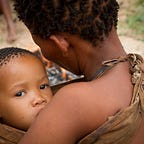
It’s been a long time since I’ve done a podcast episode, but I’ve been hounding Dr. Chaudhary to come on the show for months and we finally managed to coordinate our schedules. I love everything about his research and hearing him share his perspective on motherhood and parenting in Bayaka society has been a real treat. Definitely carve out some time to give this one a listen!
I’m copying the transcript below, but it’s too long for email, so if you prefer to read rather than listen, you can see the full text in the Substack app.
Enjoy! And let me know what you think in the comments.
Best,
Elena
Interview transcript
Elena:
Hello everyone. I’m back. It’s been a long time since I’ve done a podcast episode, what with the international move and book writing, but I’ve missed it. And today I have a really special guest.
Dr. Nikhil Chaudhary is a lecturer at University of Cambridge in human evolution and behavioral ecology. A lot of his research to date has explored the evolution of social behavior and cooperation through field work with Bayaka hunter-gatherers who live in the rainforests of northern Congo. I have read almost every one of Dr. Chaudhary’s papers and believe he and his colleagues have produced some of the most interesting findings on contemporary hunter-gatherer societies in the last decade.
In this conversation we are going to cover why hunter-gatherer research is still so important and relevant today, we are going to spend the bulk of the interview talking about collaborative child-rearing in hunter-gatherer societies. We’ll also talk about the role of fathers, and how sleep works for children in Bayaka society. Even though I have read most of Dr. Chaudhary’s papers and am intimately familiar with most of the recent hunter-gatherer research literature, some of his insights really surprised me. It seems that, even I have been underestimating the massive, massive amounts of help that mothers probably got from the whole group in our evolutionary past. Things like allonaternal nursing, where babies are fed by other lactating women while the mother works, seem to just be the norm in many of these societies.
And so, once again, I am struck by how the way we mother in the contemporary west, and the way we think about what is “natural” for mothers in our culture, is truly, truly weird.
I hope you enjoy this conversation as much as I did…
So before we get into some of the more specific questions I have for you, and I have so many questions for you, I want to start just by asking you to help us define this concept of evolutionary mismatch and why research on hunter-gatherer societies is still relevant today. I’m sure you could ask this quite a lot.
Nikhil:
Yeah, no, I’m actually smiling because I’ve had endless discussions, particularly over the last year or two, about actually how we should define mismatch and how it’s often used to refer to so many different things, but often those are sort of quite pedantic. I do at some point want to write about all the slight nuances and different forms of mismatch but to give a broad overview of what we mean by that term is the fact that an organism is or at least certain traits of an organism, certain features of their physiology or behaviour or psychology in the case of many species is adapted. Each of those aspects of those systems and different traits evolved in a certain social or environmental context and is adapted to function in that context.
And as a result, when you take that organism and they’re exposed to novel conditions, so some new conditions which are different to those of the conditions that the traits evolve to function in, that can lead to maladaptation or dysfunctional. Effectively, the system and the trait isn’t functioning correctly because it wasn’t designed to function in these new conditions. Now, importantly, there’s not always a mismatch because humans are super flexible and in many cases.
Different aspects of our bodies or our brains can, they’re very plastic and they can sort of within the lifetime adapt to the given circumstances they’re in rather than being this fixed, fixed to some particular set of conditions. This is all underpinned by the fact that natural selection is really slow, right? We wait for the mutation and then it’s a lot, if it is beneficial in the new environment, it takes a long time to spread.
So because natural selection is slow, have this adaptive lag where often we see some traits take a long time to catch up to novel conditions.
Elena:
Right, yes, the two criticisms that I hear most often when I’m sort of writing about hunter-gatherer societies are A) as you mentioned, humans are incredibly flexible. So there’s really no reason for us to replicate the conditions of hunting and gathering in contemporary society. And B) that, well, it has been 10,000 years for many European populations since we lived as hunter-gatherers. And some forms of evolution can take place in that amount of time. What are your thoughts?
Nikhil:
So yeah, to respond to those, the first one I think...
I think part of the issue is that different disciplines, even within the evolutionary social sciences or evolutionary sciences, sometimes they have these starting assumptions which are a bit too broad brushed. So evolutionary psychology really emphasizes mismatch and this, you know, we’ve got stone age minds or whatever and adaptive lag. And then another really key one when thinking about human behavior is human behavioral ecology, really highlights how flexible we are, how responsive we are to environmental changes and different conditions and to some degree largely rejects the idea of mismatch.
And I think in reality neither are right, right? There are different levels of adaptability, some traits are more flexible than others and to disregard mismatch is somewhat naive and equally to think mismatch is always the case is also naive.And it depends on the given trait.
And the second criticism you mentioned was that some forms of evolution can take place very quickly. Yeah so in terms of actual evolution happening quickly, again I mean evolution can happen in theoretically in one generation right? You could have some new virus that comes and only some very small proportion of the population happens to have genetic immunity to that virus but it’s completely fatal and very quickly you’re going to see that mutation that particular genetic, the particular polymorphism we call it at that locus will become the only one that exists because if it’s entirely fatal, then it’s gonna go extinct. So really the speed at which natural selection happens depends on a number of things like the degree of variation we see existing in the population, how strong, how the magnitude of the effect of the new conditions on survival and reproduction. If these only have small effects on survival and reproduction, it’s going to take a much longer time for natural selection to play out. Whereas if it’s a fatal early life effect, then it can happen rapidly. So again, it’s about not saying one or the other, but thinking about how different traits will evolve at different speeds based on environmental changes.
Elena:
Or I imagine just the complexity of the change, right? If like we’re talking about a single gene mutation, like in lactase persistence, for example, that can happen very quickly. Whereas I think when we’re talking about things like human psychology, you can make a stronger argument that it’s difficult for that to be overhauled even within 10,000 years.
Nikhil:
Yeah, I think it, yeah, we talk about constraints and often we talk about phylogenetic constraints, which is slightly different, yes, natural selection is always building upon what it has. And when we’re about psychology, we’re talking about shifts in the brain or the endocrine system and how hormones operate. And yeah, so changes have to...changes can only build upon that existing scaffolding that exists. there are, again, it varies by psychological trait. There is evidence that certain psychological traits probably could evolve quite quickly and others would be harder to, it would happen at the slower rate.
Elena:
Interesting. Okay, all right, well, let’s move on to one of my favorite topics, which is the topic of allomothering. So for those that have maybe not heard this term, allomother just means a caregiver other than the mother. So when we talk about allomothering, it’s parental care, ⁓ not parental care, sorry, care ⁓ of dependent offspring occurring by someone other than the mother, which is actually quite rare in mammals, as I understand it, but seems to be the norm in human hunter-gatherers. So across most, maybe all, human hunter-gatherer societies, from what I’ve read, mothers get tons of help from others in the community with parenting. Parenting is almost never done in isolation like it is for many contemporary Westerners living in single-family homes.
So, Nikhil, you wrote that, “the idea that women should be able to manage caretaking primarily alone, using their maternal instincts, remains pervasive. Many people assume this is the natural human way, except it isn’t.”
So can you elaborate? What do you think is the norm for human mothering?
Nikhil:
Yeah, I mean, I think in that quote, it speaks to something which is that there are actually sort of implicit evolutionary undertones in some of these arguments, people are talking about what’s natural and what’s been the norm in the human past. And yet that couldn’t be further from the truth. So the reason we use the term allomothering rather than perhaps alloparenting some of the time is as you sort of alluded to, at least paternal care is fairly rare in mammals. It happens in probably 5 to 10 percent of mammalian species. So we won’t assume that. The degree of allomothering can vary. I wouldn’t say it’s very, very rare in mammals, individuals other than the mother being involved, although it’s particularly pronounced in humans. But, you know, even mice can have interesting features of allomothering.
In the human case, yes, it’s entirely normative and what’s going on, even in terms of just the parents being the primary caregivers, so even with paternal support, is pretty unusual. There was an interesting review called Who Keeps Children Alive? And they found that in every society that had been studied, someone other than the mother was having a positive effect on child survival, which of course is indicative that that’s (and these were all natural fertility societies. So societies where they hadn’t undergone the demographic transition, i.e. they were still having lots of babies and contraception use wasn’t normative as such) So, yeah, there’s clear evidence looking at child survival and then in actual observational studies of childcare, again, when we look outside of WEIRD context, which I imagine your listeners probably know, WEIRD stands for Western Educated Industrialized Rich and Democratic, which is quite an apt acronym given, I think the nuclear family epitomizes the weirdness of these Western societies insofar as it is so different. In most, in the hunter-gatherers, yes, it’s very, very pronounced, the degree of allomothering. Who’s providing that allomothering? There’s some between population differences in that, but it is, I’d say, universal that individuals other than the mother are heavily involved in child rearing.
Elena:
Yeah, yeah. So one thing that I’ve always been really curious about is, there are a couple of papers, in which you were a co-author, and then, so if I understand correctly, you focus more on the Bayaka, right?
Nikhil:
Yeah.
Elena:
Okay, and then you often collaborate with Abigail Page and people who are experts in Agta society. So there are some really interesting papers you produce where you’re comparing the allomothering structures in these two societies, who cares for children, and finding that they’re quite similar. One thing that I’m always shocked to see in the data that comes out of these papers is that, for instance, in Agta society, I think the stat was that, even for children under the age of two, mothers are only doing about 25% of the caregiving for their own infants. And I am curious as to how we can reconcile that with the fact that breastfeeding tends to be so frequent and on demand in hunter-gatherer societies. Like, I think Melvin Konner found that among the !Kung it was like once every 13 minutes for the first 18 months of life, which is a drastic departure from how most women are told to breastfeed in WEIRD societies. How does that even work?
Nikhil:
So if we go to that figure in the first instance, you do see some variation. I think that 25 % is probably...I mean there was one, I’m not sure exactly which paper you’re referring to, there was one paper I wrote and we found that was to do with the amount of time spent in close proximity to kids which isn’t, I mean...Well, one thing to say is that 25 % doesn’t mean the mother was only in close proximity 25 % of the time, because say you and I were both in close proximity to a child constantly, that would mean 50 % of that child’s close proximity interactions were with me and 50 % of their close proximity times with me and you.
So it’s possible to perhaps the more useful thing without going into the nuances of that figure to just describe quantitatively what I’d say is going on. I would say generally mothers are providing about 50 % of the care or around that and it differs on the type of care but that’s even true for infants. And bear in mind some people might look at that and say, well, here we’ve got fathers and mothers. But I think the reality is mothers provide probably more of the hands-on care than fathers in most families, and particularly during periods of maternity leave when the child’s very young. And often, paternity leave doesn’t match maternity leave. Of course, mothers are doing the vast majority of care then. And the third real difference is, to put it bluntly, the amount of care children are getting there, you could sort of argue at least hands-on care where they’re really being attended to in a way that they’re the primary folks of the caregiver, is much higher there. So 50 % there is substantially higher than 50%. 50 % of care coming from helpers there adds up to a lot more than 50 % help you’d get here.
So if we go with the figure of around 50%, again, there’s lots of variation, but we’re looking at something like that.
And how this matches, you know, can be reconciled with breastfeeding. There are a couple of things. One is allonursing, which I wouldn’t say is normative. It is a lot of cross-society variation in the prevalence of allonursing. And by that, mean individuals other than the mother breastfeeding. That can explain a little bit. But then again, I mean, large part of it is as children become less dependent on the mother’s milk, you know, where they have some supplemental feeding, then of course that opens the scope for other individuals to be involved. And even when they are reliant on their mother’s milk and they are being breastfed on demand and it is by the mother, not someone else, that doesn’t mean that, you know, we can’t be in a hut where there are five people around. And when the baby needs something, someone else attends to the baby and the mother gets involved when they decide the baby needs to be fed but other people are still contributing a lot and the mother’s still around to feed the baby if that’s the action that’s going to be taken but that doesn’t mean all the other care can’t come from others and I ought to, I mean what’s relevant here is to say actually the existence of what we refer to as childhood is unique amongst humans and very much evolved around. So typically what we see in other great apes for example is this shift from when children finish when the young finish nursing once they’re weaned very soon after that they’re nutritionally independent and can support themselves. Whereas humans have this weird thing which would so that is infancy to the juvenile period of self-sufficiency. Humans have this weird thing in the middle called childhood. Firstly, so we get we’re not independent for a long time even after weaning, but also that early part of childhood altered.
That refers to the fact that if you extrapolate the primate pattern, we would expect human children to be weaned around the age of six or seven. Actually, if we look across hunter-gatherer societies, maybe we could say on average they’re weaned around between two and three on average. And the reason for that early weaning is because it means that the child doesn’t need to be around the mother all the time. If they’re relying less and less on the mother’s milk from earlier ages than we’d expect, it means other people can get more and more involved in raising the children. And that’s what you were questioning in some ways. The fact, what we are seeing is we’d expect that breastfeeding on demand happened for way longer than we see in humans, but it happens, it reduces much sooner than we’d expect, to allow for other people to get involved.
Elena:
Yes, yes. And so is it fair to say that for the first year and because the other thing, right, is that as the child matures, even let’s say that the child is breastfed for three years, breastfeeding that’s happening the first year will be much much more frequent than it will be in the second and third year, which means that even if breastfeeding is still happening, mothers can go out of camp to forage without a child. So it’s not that there’s this strict cutoff, but that in general children who are not yet weaned probably have to be in physical proximity with their mother most of the time, even if they’re not being directly cared for by her, but then this constraint disappears once the child is weaned.
Nikhil:
Yeah, so as I mentioned there’s allonursing, so I remember one camp I stayed in there was so much allonursing that went on there. in some, I think that was probably the most isolated camp and remote camp I was ever in. And maybe we could say that’s indicative of perhaps the way they were living was a bit more similar to the sort of typical hunter gatherer lifestyle. Although, yeah, I’d be careful before concluding that. But allonursing was rife there. And it, I think ⁓ probably about two-thirds of the, I mean they’re not that many infants in the camps, they’re not that big, but a lot of the infants, more than half, I saw allo-nurse and that was just in my observations and for the five weeks I was there and that would often happen when the mother wasn’t in close proximity so the mother could go off even with very young infants, could go off and go foraging because there were other lactating women in camp who would breastfeed the children.
Now the role or prevalence of allonursing is something that varies in the hunter-gatherers. So we can’t say that that is necessarily normative or has always happened in human evolutionary history, but I think it certainly wasn’t uncommon. And that does allow mothers to have some time away even from young infant rest or going and do other activities.
There was something else I was going to say on that point. ⁓
Yeah, and what you would often see in those cases is when the mother gets back, the first thing she’ll do is pick up her baby and breastfeed the baby. But yeah, that constraint isn’t fixed even for very young children. Yes, that’s what I was going to say. I mean, allomothering probably is more the society for me where it’s so pronounced is the Efe who are another population of central Africa. And there you see they have this interesting practice where other women in the camp when the baby is born it will be the mother if I remember correctly the mother nurses her own baby last so all the other women will come to the baby before she does and the the extent of allonursing and alloparenting is super high I think they found it was maybe by 14 weeks a child was being transferred across caregivers eight times an hour, had 14 different caregivers a day. So yeah, very, very extreme allomothering.
Elena:
Yes.
This was fascinating because I’ve seen that research on the degree to which children are transferred between caregivers in the Efe, but I have not seen anything specifically published on allonursing. And I had no idea that it was, my assumption was that allonursing happened, but it was kind of like a stopgap, in case the mother wasn’t available for some exceptional reason. I had no idea that in the Efe they would go around and feed others babies. I mean that changes everything, because nursing really is the constraint that human mothers face when going out of camp or being separated from a baby. And it’s interesting to think again about how you mentioned how this varies across societies, because, for instance, in !Kung or Juhansi, which I cannot properly pronounce, Melvin Konner has written a lot about the intensity of maternal primacy in that society. And I think the stat is that mothers are in close physical contact with their baby 70 % of the time, over the course of the first year or maybe 18 months. So it does seem that there is quite a spectrum.
Nikhil:
Yeah, so, and again, I would just say even if mothers are in close contact 70 % of the time, that doesn’t...you know, it may be that a lot of that time someone else is also in close contact or someone else is also getting involved if the baby needs to be soothed or washed or someone else is playing with the baby at the same time. But yeah, I think it’s fair to say there’s maternal primacy. It’s about whether cumulatively, allomothering is providing substantial support to, so you’ve sort of got these two things going on at once. Loads of non-maternal care, but still maternal primacy, because that non-maternal care is often coming from multiple sources. They’re not always. I think there was one study of the Martu who were Australian-Aborigines, and there you see the grandmothers providing a lot of care. that rather than the allomothering being widely distributed, you know, it’s not quite as much as the mother, but it’s not that far off. That paper’s actually called the grand maternal niche. With regard to that allonursing and the constraint, yeah, there’s very little published on it. That point I just made about the Efe, and not 100%, but I’m fairly sure. And it’s just, you know, a couple of sentences, a sort of ethnographic observation made in one of the those papers but not focused on and really I think one of the main papers on this is Barry Hewlett has a paper on allonursing in Central African Pygmies. I am actually involved in a project on allonursing across mammals which will be coming out soon and trying to understand when it does occur and how.
I’m not leading it, but the lead authors are creating a database where you basically have every study that’s ever been done and whether we can work out the, in mammals and whether we can, where there’s some indication that allonursing is or isn’t happening and the degrees for people interested that will be.
Elena:
I can’t wait to see it.
Let’s get into, I know you touched on this, but let’s get a little bit more into who is helping. And again, this is something that seems to be pretty consistent across many societies, and it’s a bit surprising I think for many people, it’s not who we’d expect is it.
Nikhil:
Yeah, you’re talking about other kids, right? Yeah. Yeah, I think they’ve been neglected a bit. I mean, people might say, well, Karen Kramer wrote about this. And she did, she gave a lot of attention to them. But I have to say, I think the literature on allomothering and provisioning or care has been dominated by a comparison and debate about the relative importance of fathers versus grandmothers in human evolutionary history and other kids have been neglected until recently. And in one of my papers, I did try and find data where there was some on subadult caregiving. So, basically children and other adolescents providing care. And there wasn’t that much out there, but when there was, in all of those cases, the subadults cumulatively were providing more than 50 % of the allomothering, right? So it would be fair to say they’re the most important. We have to be careful in extrapolating that to assume the quality of care provided by an adolescent is the same or a child is the same as from an adult or an experienced mother, but in terms of the quantity of care, and the time spent, it’s super high and that’s super consistent across hunter-gatherer societies where we have the data.
Elena:
And it’s very, very young children often too, correct?
Nikhil:
Yeah, that can start from a very young age. I mean, I feel like...
At the lower end, there will be instances where you might see a three-year-old getting, having some involvement. I’d say it starts to increase sort of maybe not unusual to see a four year old having some involvement and then that to steadily increase with age. Often this child caregiving, not always, certainly not with slightly older kids, but often it’s happening in the context of mixed age settings. So by mixed age, I mean mixed age children and adolescents. So as the child,
as the infant becomes less and less reliant on their mother’s milk and certainly once infancy is over much of the day is spent in these mixed-age playgroups with kids from around two all the way up to say 15, 16 and they just they may be in camp a lot of time playing amongst themselves. We call them playgroups. I mean that’s probably a bit of a misnomer given that we use that term very differently in our society. I guess what mean is the close proximity is among these children of different ages and that may be in camp where other people are around including adults but they also just go off and do their own thing elsewhere and obviously when there aren’t adults around they are the ones playing a role.
You mentioned from very young ages I’m interested in looking at what this really examining the specifics of what the caregiving looks like in those very young ages. But there was one developmental psychologist who’s very well known called Judy Mesman, who looked at some videos my colleague had taken. And that was by a kid who was about some caregiving by a child who was about four. And she concluded that that child at four years old was demonstrating sensitive caregiving. This is caregiving where the caregiver is correctly able to notice, interpret and respond to signals from the care receiver.
Elena:
Incredible.
I mean that just blows my mind because when I think about my children, my son is six, my daughter is four. Their relationship is unfortunately characterized mostly by jealousy and disputes and I have to sort of intervene and help them regulate themselves and their behavior more. I would say that my son, for better or for worse, and I love him very much, but he is more of a net detriment to my ability to, like, let my daughter play independently than he is a helper. I mean, Why? What? How? I mean, how is this achieved? How do you train a four-year-old child to be a sensitive caregiver of a younger sibling?
Nikhil:
Right. Yeah.
So the... I would say, don’t get me wrong, there are disputes for sure. Kids annoy each other very much like they do in the context we’re familiar with. ⁓ As for training, guess the thing is that it’s not really training. This sort of happens, at least from what I can see. And as I say, I think this needs to be looked into more and something I want to do. ⁓ It sort of happens organically, I think, through just observing what others are doing and trying it out. And it speaks to something, which is more, which is not specific to childcare, just that kids are given a lot more autonomy and given the opportunity to explore a lot more. So it’s not only that they’re exploring and getting experience in caregiving from a very young age, but they’re exploring other parts of the environment. You know, there’s, you will see kids who have just started walking or maybe aren’t even walking yet and they’re probably, you know, around one year, one year of age, exploring a machete or, and certainly by, you know, two or three, they’re practice it, you know, playing with that machete and practicing a bit or exploring the fire and, know, kids are competent machete users and fire managers at a very, very young age. So I think there is a surprise at this. It is just a reflection of our cultural norms of not giving, having too little, giving too little credit to what very young children are capable of if they’re given the opportunity to do different things.
Elena:
Yeah.
Yeah, I don’t know if you’ve read, Michaelene Doucleff’s book, Hunt, Gather, Parent, talks a lot about, yeah, giving children more autonomy and childhood and how this is a very sort of universal feature of growing up in these societies. It definitely influenced my own parenting a lot, but I would say that, well, maybe not all, but many parents would love for this to be the norm in their homes because it in theory makes parenting so much easier, but it feels impossible to do. Um, and I just wonder why that is. I mean, is it, you know, and I know that this can get into kind of difficult and often guilt-inducing conversations, but I tend not to be shy about that because I’m really interested in getting to the truth. I mean, is it potentially related also to just the level of sensitive caregiving that hunter-gatherer children get that maybe influences how sort of pro-social they are?
Nikhil:
Yeah, so, I mean, in terms of why it doesn’t really happen here beyond us not giving the opportunity so much, I think part of it may be the context of there always being other, most of the time being other people around, I mean, in the household, of course, the parents are around, to intervene if necessary if a younger child was looking after their even younger sibling. So yeah, I guess that doesn’t really explain it because the parents would be around. As for the sensitive caregiving, the I wonder actually just to go back to that point, I do think a large part of it may be around just from when the child, when the youngest child is very, very young, I do think even though we would like our children, well I don’t have kids, but children in our society to have some involvement, we would display quite a lot of restriction like, no, be careful or no, no, no. We might let them at most, we might put the baby on their lap, but we’re not really gonna, or the infant on their lap, but we’d be quite hesitant to let them hold the child. So I do think a large part of it might be sort of restricting the opportunity. And once you do that early that’s gonna then have knock-on effects for how much that competence can develop. As for your question, were you implying that by receiving more sensitive caregiving that may then have a knock-on effect for providing caregiving as a child? was that what you...
Elena :
Hmm.
Yeah, I mean, I think it could be two things. One is that, you know, I think just based on what we know about like attachment theory, for instance, child who receives quite a lot of sensitive caregiving will often grow up to be more independent. So could there be a relationship? Yes, like a knock on effect, as you’re saying of because they were so competently cared for by the entire community and by their mothers that they then are that has an influence on their pro-sociality and their independence, but also because of the modeling that they’re getting from other adults and the way that infants are cared for that they see this happening and they want to imitate because as we all know children are our little imitators. ⁓ I don’t know.
Nikhil:
Yeah.
No, I think that’s definitely plausible. If it does follow from one to the other, mean, people would debate the degree to which sensitive caregiving is necessary for the development of independence. But of course then, yes, if they are more independent, if we accept that premise, then why wouldn’t that express itself and manifest in them providing care to others? And in terms of modeling, I guess, yeah, there’s far more models around for a start, right? They’re living in these communities and they’re seeing loads of different babies being cared for so they’re just exposed to many more instances of caregiving and maybe there’s just both in terms of the number of kids but also the duration because kids, hunter gatherer kids, you know if you look at how often they’re getting attentive care it does seem to be a lot more than in our society for example they’re being held for a longer amount of time so I guess both in terms of the number of models and how frequently, how many hours a day they’re actually observing, this is how you hold a child or this is what you do when a baby’s crying. So yeah, those two things perhaps just add up to more exposure and as you say, kids are imitated. So maybe all three of those things probably have a cumulative effect. But as I say, I think we don’t, at least in Hunter Gatherers, this hasn’t really been explored, the process by which this happens. ⁓ And it’s something very much higher in my priority list to do. yeah, I don’t think we a firm understanding... ⁓
Elena:
Yes, I think a lot of us would be very interested in the answer. Just because I think, you know, again, most parents would like for this to be the case. I mean, parenting would be so much easier if our children were as independent and as competent as hunter-gatherer children seem to be, based on, you know, the literature and talking to you. And yet even those of us who are aware of this gap and aware of the fact that we should do everything we can to be giving our children more responsibility and autonomy are consistently falling short. ⁓ And so what is it? Like, what is it? What’s the difference? I mean, I’d love for us to be able to come to some empirical conclusions about this. ⁓
Nikhil:
Yeah.
Yeah, and also I think probably the mixed age settings are important that we really divide kids by age a lot more than what we see in hunter-gatherer societies. So again, there’s fewer models and less of that context in which kids are away from adults and sort of have to do a little bit, even if it’s like some acute soothing and taking the kid to an adult. We’re just not giving the context an opportunity.
And just on this point of, you know, all parents, a lot of parents would like this extra support and it’d make their life easier. Just want to bring up the other side, the other benefit, which is that, you know, first time parents would probably feel a lot better equipped in parenting and a lot less anxious about parenting if they had been helping with caregiving since they were four years old, right?
Elena:
Yes. Right.
Nikhil:
I’m at an age where a lot of my friends are having kids for the first time and feel completely overwhelmed. Their self-efficacy is very low. They’re always questioning themselves. And my colleague who’s a child psychiatrist, but obviously dealing with parents a lot as well, was talking, I believe it was one of her patients.
I said to her, you know, I’ve never, or sorry, the mother of one of her patients, technically, I had never held a baby before my own. And I mean, I don’t know, that’s perhaps not super rare, but...
not the majority, a lot of people have held a baby, but yeah, the fact that that’s probably not that uncommon in our society is just a world away from what we see in hunter-gatherers.
Elena:
Right,
and so when I talk about this phenomenon of alloparenting by children, I often get criticized for advocating for parentification. And I always push back and I say, know, parentification, like in...
in the psych literature is really like extreme cases where a child is like barred from going to school or has to take care of like addicted parents or like having your child like I think you know we conceptualize making a six-year-old child do anything accept play as, or school as harmful, like having them help out with a younger sibling as parentification, right? When in fact, I think, as you say, there are tremendous benefits to children being involved in caregiving because that’s how I think many primates learn to parent, right? Like there’s a good argument, I think, to be made that primate parenting is largely a learned skill, right?
Nikhil:
Yeah, or at least in part. don’t know, there’s not that much testing of the idea, but one of the sort of early studies which formulated this, when there is allomothering, right, when there’s any form of cooperation or what you might call altruistic behaviour, in the animal kingdom, it raises the question of, well, why was this selected? Why wouldn’t being selfish have prospered? Why would we have genetic dispositions or drives towards helping? And that’s the case for alum mothering. Why would this have been favored by natural selection? And one of the hypothesis is this learning to mother hypothesis. And that initially developed by someone who was studying verbit monkeys and found the more time juvenile females were looking after other women’s, other females’ babies prior to reaching sexual maturity themselves, then that was associated with higher offspring survival amongst their children because they had had more experience.
that much data demonstrating that and that would be really interesting. But there’s not that much data. I don’t mean there’s conflicting evidence. We could just do with a lot more testing of it.
Elena:
Yeah, yeah. Another thing that I love about the literature on multi-age playgroups and care of children by children is that children all have this inherent motivation and desire to play, ⁓ which I think, correct me if I’m wrong, is just not true of mature adults, at least not to the same extent or in the same way. And so, ⁓
In my personal experience of parenting, and this is a topic that has really resonated with my audience, I do not enjoy playing with my children for the most part. I love my children. I love cuddling them, snuggling them, caring for them, having them around. I do not want to engage in their imaginary games. ⁓ And yet my children constantly solicit me to be involved in their play, and I think part of this is just the sort of lack of other available playmates that are around, and I think that’s probably one of the reasons, honestly, that these multi-age play groups end up being such an effective form of substitute child care, is just that when children have one another,they’re able to engage in this form of highly social imaginative play and they don’t then solicit their parents to fill this role for them. I don’t know if you have any thoughts on that.
Nikhil:
Yeah, I completely, completely empathise with the... I mean, I like playing. I’ve got...a lot of godchildren and I enjoy playing with them for a little bit of time but it is exhausting especially when that play involves like running around and stuff I mean it’s I don’t have kids myself so I only have to do it for short spurts and I am wiped out ready to sleep till midday the next day after after that ⁓
As for, ⁓ yeah, I mean, I just completely agree with you. I think it is just a matter of there not being other available playmates. And importantly, it’s not. I guess our. Our dynamic is depending on the child’s age, there’s also, you know, they need to trust the people they’re playing with as well, particularly at a young age, given kids might not be have the opportunity to develop attachments with many people other than their parents, then it might not be as trusting and willing to or it might not be their first choice to solicit someone else over their parents. But for the most part, yeah, I think it’s down to what you say, just their own other people around and if there were one they could develop trust with those other kids who were around to be playmates and they certainly would play with them all the time and you wouldn’t have to do it.
Elena:
Yeah, I I think it was in this same paper, this children are important too ⁓ paper where Abigail Page is the lead author where, ⁓ yeah, I think at some point she says that like mother’s involvement in play is virtually non-existent. Like she kind of looks at, okay, caregiving is split across all these different kinds of alloparents, and such that mothers are potentially doing as little as 25 % of active care. But then if you look at the kinds of care that mothers are doing, ⁓ there’s sort of a deep dive on that too. And if I’m understanding the study correctly, it seems that what the mothers are doing is the kind of tending and caring and feeding work and almost never playing. Most of the adults, in fact, are almost never playing. The play is really what’s done in these multi-age play groups. And so I think that this sort of contemporary expectation that to be a good mother, you must play with your child is just kind of sets us up for burnout because like you say, it is so exhausting, especially if we also have all of these other very real responsibilities to tend to around professional work or just maintaining a home or whatever it is.
Nikhil:
Yeah.
Yeah, no, I very much matches my observations that, you know, parents and adults generally are not playing with kids much at all. And this is happening in the multi-age playgroups. So, yeah, a world away from what we’re used to. And kids do need that play, but we want to create a context in which that burden doesn’t follow. I say burden, but yeah, if you’ve got a lot of other things to do. It can be a burden and tiring. That burden doesn’t fall entirely on the parents and you know that other kids can get involved. mean when they’re at school we all enjoy playtime when we’re kids at school. just want to more opportunity for that in other contexts.
Elena:
Yeah, yeah, and I do think that probably there’s limited research on this, but that parent play is a poor substitute because there’s a like a different power dynamic and the relationship between children who are peers versus an adult and a child, right? ⁓
Nikhil:
And to some degree you’re faking it, right? Like you might be enjoying it, but you’re not enjoying it in the same way that...another kid would be enjoying it. You you’re probably enjoying it because you’re enjoying seeing your kid happy and seeing them laugh, but you’re not seeing it through the eyes of another child. So it’s just a different type of shared experience, which you can imagine why it might be, in terms of the activity itself, more fulfilling or more mutual when it’s done with other kids.
Elena:
Yeah.
Right.
So I want to touch on another point that we’ve kind of been skirting, which is that in most of these studies, fathers are not that involved in active child care. I mean, it’s certainly nothing like the 50-50 we would hope to see or that, you know, many contemporary feminists are advocating for. ⁓
That said, I mean, I have heard that in certain societies, like the Aka are very famous for having a credibly sensitive and involved father, so there does seem to be some variety. But again, I was quite disappointed in the conclusions of some of these papers, saying that, I can’t remember which it was, whether it was the paper that compared aloe parenting across Bayaka and Agta, whether it was the one that just focused on the Agta. But one of these papers reached the conclusion that fathers didn’t really provide any measurable form of substitute of child care. ⁓ and how should we interpret that? I mean, that that is a bit disappointing for those of us who are hoping for more co-equal partnerships, especially in, ⁓ you know, an economy where many mothers also have to work full time and the only other person living with you is the father.
Nikhil:
Hmm.
Yeah, I mean, the figures, I feel like paternal involvement is one of the most variable things we see across natural fertility populations. And as you mentioned, the Aka, sort of famous best dads in the world, and where I work, which is like just down the road from them on the global scale, its fathers were providing yeah probably about 10 % of allomaternal care. That’s
higher in that Agta or at least time spent in proximity. If we looked at, when I looked at proximity and the proportion of proximity time with different allomothers, and again, bear in mind, if we’re both, if we are both allomothers and we’re both with a kid constantly, then 50 % of that time is with me and 50 % of you. That’s how, how it would be quantified rather than 100 obviously because I’m looking at the relative proportions. Fathers in terms of proximity time, think with that Agta it was 17 % of allomothering time and with Bayaka it was 10%. A lot of it is about availability of other caregivers. I think that’s a large predictor of how involved fathers are.
And I guess it just ⁓ I’m one of the reasons that Barry Hewlett put forth for why the Aka fathers are so heavily involved is because women are also going hunting. So that changes the division of labor. It also means there’s more time where on hunting trips, you know, on the walk there and the walk back, the father’s with a kid. And yeah, so I think, you know, this is just one of those things where what works is always going to be different in different contexts and sometimes we want to think about okay how do we reshape the context and I think what we’ve just been talking about with maybe siblings or more mixed age play groups and stuff is an example where we might think okay let’s reshape the context and we can draw inspiration from hunter-gatherers and then other times we need to think well, there are fundamental differences in how we’re functioning, which we don’t necessarily want to change. We want women to have equal opportunities to men to go out and have employment away from the home as far as possible. So then we have to calibrate who does caregiving based on those constraints. And it is just weighing up relative opportunities. I don’t, in some sense…It doesn’t really matter, right, what hunter-gatherers are doing in this domain. Why it would matter is it can, like what we’ve spoken about with the children, it can offer us clues into the capacity for caregiving, right?
You know, if it was the case that over our evolutionary history, it was only ever adults who provide caregiving, it may be that younger children would have never evolved the sort of psychological capacities and requirements to be competent caregivers. But as we discussed, we know that’s not the case. And similarly, clearly in many societies, fathers have some involvement and the magnitude of that involvement varies considerably, but we can say confidently that, you know, it’s not like paternal care was absent. So clearly those capacities are there in males. And then that’s the only thing we really need to know. And then how we organise our caregiving, I think what hunter gatherers are doing, it can just be a form of inspiration of different possibilities and also give us insight into whether capacities exist or not. We might not know that very young kids are capable of caregiving if we didn’t have somewhere else to look where it actually happens. But then in terms of guiding our decisions, I’m not sure it really matters beyond that what goes on in our societies too much. I mean, there are and someone might disagree with that.
And you know questions well can you form a strong attachment with non-maternal individuals and questions around this and some debate I mean I think the answer to that is yes but so but yeah on the whole I would say who cares that hunter gatherer fathers are sometimes not that involved?
Elena:
Yeah, mean, certainly, ⁓ we’d like to interpret the research that way. ⁓ I mean, I think many of us are hoping for more equality in the division of childcare and domestic labor. I think that’s a necessary condition for women thriving in the modern workforce without this kind of double shift.
I guess, though, what frustrates me often, and maybe I’m wrong on this, ⁓ just around sort of the contemporary narratives around the gender division of labor in the home and such is that ⁓ we often characterize ⁓ men’s relative interest in pursuing paid work and as kind of...and reticence towards being equally involved in child care and domestic labor…as a kind of moral failing. Whereas I wonder, well, I suspect that men are actually just responding rationally to the way we’ve structured things in contemporary society and that there probably is an element of
biology to this and that, I don’t know, we have some research around testosterone and the role it plays in sort of motivating men to perform status seeking behaviors and that potentially this is why men focus more on big game hunting and hunter gatherer societies. And maybe it’s also why they sort of disproportionately pursue paid work and are less motivated to do childcare, then of course there is like, you know, breastfeeding, which I think is still good for women, even in the modern context, and that really only the mother can do. And so I guess sometimes I wonder whether...the optimal thing for contemporary society would just be to relax the constraints around paid work for young parents and also to facilitate other forms of alloparental care more than sort of hammering on fathers to do more. I know this is really controversial stuff and ⁓ maybe, you think again the hunter-gatherers have nothing to teach us in this regard, but I guess just seeing how maternal primacy really is a thing in most hunter-gatherer societies has made me a bit skeptical of whether we can really ever achieve a true 50-50 or whether that’s even like a desirable... is that really what we want? Like is that a sign of an empowered society, given that I think hunter-gatherers are actually able to maintain what most anthropologists consider a very high degree of gender equality, even while men and women sort of fill different roles? I don’t know.
Yeah, that was kind of a rant. I don’t know what you want to...
Nikhil:
This yeah, we said lots of things that I hope I…
I hope I can remember my comments. So.
Father’s... ⁓ yeah, okay, firstly it’d be good to... Maybe you’ve read it, I haven’t. Signpost to Sarah Hardy’s recent book called Father Time.
Elena:
Yes, I read it. Yes, loved it. Yeah.
Nikhil:
Great.
So I imagine the narrative in that was probably leaning towards, you know, how there are many components of male biology and psychology that leave them well equipped for fatherhood.
Elena:
Yes.
Under the right circumstances.
Nikhil:
Yeah, well, for it to, to, would manifest under certain, under the right circumstances, but the baseline scaffolding of biology and psychology is there. So sort of speaking back to that capacity issue that it is there. Certainly I think the 50-50, whether it’s desirable, I mean, I think our values are just, you know, they change over time and context and actually we can often identify where they come from. I mean, if you are pro breastfeeding, of course that’s always going to be some constraint, but fathers could make up in other ways. I know my brother-in-law, when my nephew was born said, well, you’re obviously doing the breastfeeding, but I’m gonna do all the nappy changing, right? I don’t want you to ever change your nappy over this period and so there would be ways to balance that.
I don’t think in terms of what’s desirable, the fact that maternal primacy is normative, that that necessarily means even maternal primacy in, you know, let’s just say for some reason this society didn’t want mothers to be involved in, and women themselves didn’t want to be involved in child rearing. I think really that’s an empirical question as to whether that necessarily has negative effects on child development. I think we don’t know much about how the identity of a caregiver has knock-on effects and whether, okay, does the type of care fathers give versus mothers give, how substitutable is it in terms of attachment outcomes? Does the mother matter? Does it matter if it’s the mother or could it be anyone who is the primary caregiver providing that being the, at least the principal caregiver, even if that is only providing 25 % of the care? I don’t think we know how much identity of the caregiver plays a role even though we do know that maternal primacy has been and is normative.
Elena:
Yeah, I mean, I’m very pro breastfeeding in general on the grounds that we do have excellent empirical data that it is important for women’s health and children’s health. I mean attachment is much more complicated, I agree, and I’m not sure the the evidence is there, but just in terms of like how many colds does the baby get in the first few years of life, and then also on things like rates of reproductive cancer, cardiovascular health, and and many other metrics, it does seem to really be beneficial for women, and so I think there is reason to promote it and facilitate it, and I do think that if you are promoting and facilitating extended breastfeeding, which is the biological norm for our species, then it does become difficult to say that also we’re going to have 50-50 split of parenting in the contemporary context. It’s a bit of a pickle, I mean...
Nikhil:
Mmm. Mmm.
Yeah, yeah, no it is. Yeah, sorry, I guess that was the underlying crux of your question slash sort of musings or thoughts. Yeah, no, exactly. Yeah, I guess that is a bit of a pickle.
Elena:
Yeah, no, I wasn’t clear in my question. I was thinking out loud.
Nikhil:
I’m sure you know, yeah, it sounds like you know the research and breastfeeding effects a lot better than I do. I mean, I know probably the stronger evidence is that there are, know, benefits in numerous domains. I know there are still people around who can test that, but yeah, that was my understanding too, that the weight of evidence at least favors breastfeeding and certainly it is a speed, mean, we’re mammals, but yeah, that does create a difficulty. I guess it is about, yeah, how can the other caregivers or the fathers in our current setup compensate in other domains? But yeah, it’s very difficult.
Elena:
Yeah. Yeah.
Nikhil:
It’s very difficult, and I wonder whether sometimes when we’re talking about a desirable 50-50, we’re talking more about a 50-50 in non-economic domains, i.e. like domestic domains, as opposed to the parenting itself. I wonder if, you know, part of what we’re talking, you know, some people would say, okay, what we really want is 50-50 in dealing with the kid. But I think what a lot of people are talking about is spreading the domestic workload. So if the father is doing all the cooking, all the other household management, other things like changing the nappies or taking the kid to the doctor when need be, maybe 50-50 can sort of be achieved at the same time, even though the mother is the primary caregiver or at least the breast feeder. So yeah, maybe that’s the sort of solution there if we want a 50-50.
Elena:
Yeah.
Yes, so I wanted to switch and talk a little bit about sleep, which I know is something that you have researched less, at least not formally, ⁓ but it’s something that my audience cares a lot about, I’ve written a lot about. I sleep trained my first child, my son, ⁓ because that was just kind of the social norm in my social circles. I kind of have some regrets about it and I bedshare with my daughter, I mean, I started bed sharing with my daughter from day one. That was a much more agreeable experience for me. ⁓ I now bed share with both of my children. So I’ve kind of been an advocate for loosening the narrative around the safety of bed sharing on the basis that I think it can be done safely and we should educate mothers how to do it safely. ⁓
But one thing that I am curious to hear your perspective on because you wrote in an article “Babies receive swift and sensitive responses to their cries and are very rarely left to cry it out. Among the kong, almost 100 % of crying bouts are responded to and the vast majority of these responses are comforting and nursing.”
I’m always a bit shocked to see how there seems to be a fairly robust empirical literature suggesting that sleep training children really doesn’t have negative effects. How can we reconcile this? Are you skeptical of the research on sleep training or do you think this is just one thing where the hunter gatherers offer us no guidance?
Nikhil:
I think most of those studies, the hunter-gatherer studies, are actually on daytime crying. So I think what the research, a lot of...
You know, some sleep training and not constant responsiveness is probably fine or doesn’t have detrimental effects, but the child still needs sensitive responsive care in other contexts outside of sleep. And it’s not that they don’t need responsive care at all. It’s just that it doesn’t have to be all the time and doesn’t have to be present throughout the night.
So I guess in terms of reconciling it, there’s not necessarily an inconsistency there because those studies and hunter-gatherers are talking about responsiveness during daytime. It’s very, I mean, of course it’s hard to know what goes on at night because typically at least the people doing these quantitative studies aren’t staying in the same huts. So we don’t see so much what goes on at night.
Elena:
Hmm. Hmm.
Nikhil:
But yeah, I don’t know if that in and of itself was a sufficient answer, but I don’t necessarily see an inconsistency there. Maybe where there is an inconsistency is studies which show, which are on daytime crying.
in the West and show no negative effects of that. Not that those are all of them, plenty of studies that do show negative effects and there are studies that don’t. I would say the weight of evidence shows probably that responsive caregiving does have positive effects but...
But there are studies which indicate it doesn’t and leaving kids to cry it out during the day at least some of the time is a fair amount of time isn’t necessarily problematic, at least at certain ages. So again, I think it’s an empirical question, but overall, I think whilst this is such a debated topic, and I’m always nervous to, because I don’t feel like a complete expert on the topic, especially not on sleep training or what goes on at night time. But I think overall, it wouldn’t be unreasonable to say the evidence generally suggests that an overall responsive strategy when we’re considering caregiving as a whole, not just sleep training and night time, has positive effects. It doesn’t need to be all the time. And that overall conclusion isn’t inconsistent with the high responsiveness we’ve seen on togetherness of course because it seems like responsiveness is a good thing.
Elena:
Yeah, and I mean, even though we don’t necessarily know what goes on at night, you know, infant mother co-sleeping is a primate universal. And of course, all hunter gatherers do sleep in close proximity with their babies. We do know this. And there has been some research, I think, Alyssa Crittenden did an interesting study with the Hadza ⁓ and how actually it helps breastfeeding mothers in that context get more sleep. And so I just think it’s quite surprising to see, you know, given what we know about the way that hunter gatherers sleep with their children, given what we know about the importance of, well, like you said, the evidence is mixed, but again, it seems to me that the weight of the evidence is on responding to crying being good for children. That then we also have this body of research saying, OK, but at night it’s fine to let a baby scream in their crib for hours. It produces no negative effects. ⁓ But perhaps it’s just that, you know, as long as the care during the rest of the time is good, that you can do this for a couple of nights and your baby learns to sleep better and it’s fine. I don’t know.
Nikhil:
Yeah.
I think, I mean, yeah, I mean, I would agree with you that my observation of, at least of naps during the day, is there’s this sort of seamless thing where the baby is breastfeeding and the mother and baby both almost still asleep? It feels like the baby is sort of breastfeeding while simultaneously being asleep more or less. So so I can totally see of course there are many other considerations with co-sleeping, but I can totally see how that could be beneficial to minimizing sleep disturbances.
This question of overall, I mean, I know there is a study which is often mentioned, or at least I remember reading about, well, the kids even start crying less and less, but if you look at their cortisol levels, they still remain raised. But I think there’s contradictory evidence to that too, and maybe the sampling has been criticized in that study. I guess it’s... my conclusion would sort of be like what you said there, that maybe it’s a bit surprising but for me this is the very reason why hunter-gatherer should only be clues rather than us assuming that’s the best way. And it may just be that overall the child needs a sort of general sense that there’s sensitivity and there’s responsiveness and that doesn’t need to be there 24 seven.
I wonder if someone studied this. They probably have. How much these... Because there’s one thing about... Okay, is the child sort of internal model? There’s one about caregiver availability, some element of caregiver availability when they’re distressed. And then there’s also caregiver willingness. And I wonder about the differential effects of a child not being responded to when they can’t actually see a caregiver’s present. So yes, they’re distressed and it’s like, ⁓ there’s no caregiver available to me. And that may have its own independent effects to what goes on when I can see there’s an adult present, but they’re choosing to respond to me and that may have different effects and they may interact. I’m just thinking out loud here, but you can see the distinction between daytime and nighttime. Yeah, because at nighttime if the kids in another room, they don’t even see that it’s sort of more biophysiologically interpreted as there’s no caregiver available as opposed to the caregiver isn’t responding to me. But I have no idea.
Elena:
Yeah, it just seems a bit crazy to me that the way I sleep trained my son, which was like full blown extinction at six months, is a good thing for babies. But, but okay, let’s shift because I know we’re running out of time and I have one more burning question, which I think you partially answered here, which is just simply based on your observation of how sleep works for children in hunter gatherer societies.
I’m assuming that they’re not following a nap schedule and they’re not putting babies to sleep in a crib. So like how and when do babies and young children sleep? Is it always in physical contact with someone? Do they totally self-govern their sleep patterns? Given that they need more sleep than adults, do they put themselves to bed earlier or how does it work?
Nikhil:
I feel like it’s, again, I haven’t really isolated, you know, I haven’t studied it systematically. So I’m going on observations and, you know, my experience in terms of the value of biological anthropology compared to other forms of anthropology is that it tries to be systematic and quantifies things. And value is, we really often see that actually when we do quantify things, it feels like there’s so many biases in what we observe and take notice of and so you have to sort of focus on it. So keeping in mind that I don’t always trust my sort of recollections and perhaps biased observations, I feel like young kids and infants sleeping is very sort of self-governed. It just sort of happens when they want it to happen and there’s not really much of this, put them to sleep for their nap at this time. I really fairly strongly think that’s the case. Imean seeing the way my sister, brother-in-law deal with my nephews which is extremely regimented naps which determine the whole thing. I mean it’s yeah I know I’m saying I don’t trust my observations but I do trust my observations that that is very very it just doesn’t happen where where I work.
⁓ It’s very, I think it’s quite, yeah, just happens organically. I’m sure there are tendencies for the child to fall into routines of when they fall asleep, but it’s not regimented in this planned way, which is parent directed.
And in terms of...where it happens. I mean, I think often it is happening in contact with another adult. Like they’ll just fall asleep either while breastfeeding or laying on the caregiver. It just sort of happens in context. There was this, in these observations I did, I was looking at how often a child is alone. And by alone, I meant, they were only classified as not alone if there was someone within three meters and eye shot of them, a caregiver, someone capable of giving care within three meters and eye shot of the child. And they were very rarely alone even when sleeping. So across the entire daytime at least, even though they were taking naps and sleeping, like the infants, I think it was sort of like 15 minutes. So certainly the idea that they’re napping and being put like even in the heart and they’re not visible, that wasn’t really going on. It was very rare. So even napping is generally happening where they’re not going and being put away. They’re just sort of around and often in physical contact and they fall asleep. ⁓ Yeah. So.
Elena:
Because in your latest study, I think that was on physical activity levels in children, ⁓ there’s some data on sleep in there that shows that four-year-olds are falling asleep around 8 p.m. whereas the adults are not falling asleep or going to sleep until much later, like three hours later, I think on average, something like this. So my question was just like, where are the kids? when they fall asleep, is everyone just sitting around the fire? Are they just falling asleep on a parent’s lap?
Nikhil:
Yeah, sorry. I mean, the thing I was referring to just then, I was thinking more about infants and sleeping there as for the night time. Yeah, so the. I think. Basically, as it gets dark where I work, which is around 6pm, starts getting dark, you sort of see people start retreating to the hut or near the hut. There’s like a fire outside the huts and people will be sitting around there. ⁓ And yeah, their kids might fall asleep on them or they might go into the hut a bit earlier. But generally, you know, there’s just the time at which people are retreating into the hut, kids and adults, is not that distinct. It may be that they actually fall asleep at different times and I know we found adolescents sort of go to sleep later and they may be, you know, hanging around outside for a bit longer but I think actually the amount of time in which a young child goes to sleep
in their hut is probably not that different from their parents and often maybe in the period where they if they fall asleep before their parents maybe it may well be outside the hut just just outside the hut.
Elena:
Right, interesting, interesting. Yeah, because bedtime battles and just implementing nap schedules are another piece of contemporary parenting that is very difficult and I’m interested, I always say, you know, I’m interested in the hunter-gatherer research for two reasons. One is this idea of evolutionary mismatch and the other is just that like it provides interesting insight into alternative ways of parenting because I think sometimes we get so caught in our sort of cultural paradigms that we can’t even imagine that there’s an alternative way of doing things. ⁓ So yeah, it’s always fascinating to me to hear just the sort of, I guess, more qualitative aspects of what life is like in these societies as well for that reason. ⁓
Nikhil:
Yeah, yeah, totally agree.
Yeah, I can’t know what goes on in the hut at night, but I have to say I don’t imagine there are bedtime battles. My instinct is that bedtime battles don’t really happen there. Certainly the regimented daytime nap time battles don’t happen because it’s organically the sleep. So yeah.
Elena:
Yeah, fascinating. All right, well, I won’t take up any more of your time. I’m so grateful to you for having given so much of your time and we’ve covered so many fascinating questions here, including a lot of my sort of personal pet questions that I’ve been dying to ask you. I hope these are interesting to listeners as well. ⁓ So thank you so much, ⁓ Nikhil, Dr. Chowdhury for coming on.
Nikhil:
Thanks for having me.


